

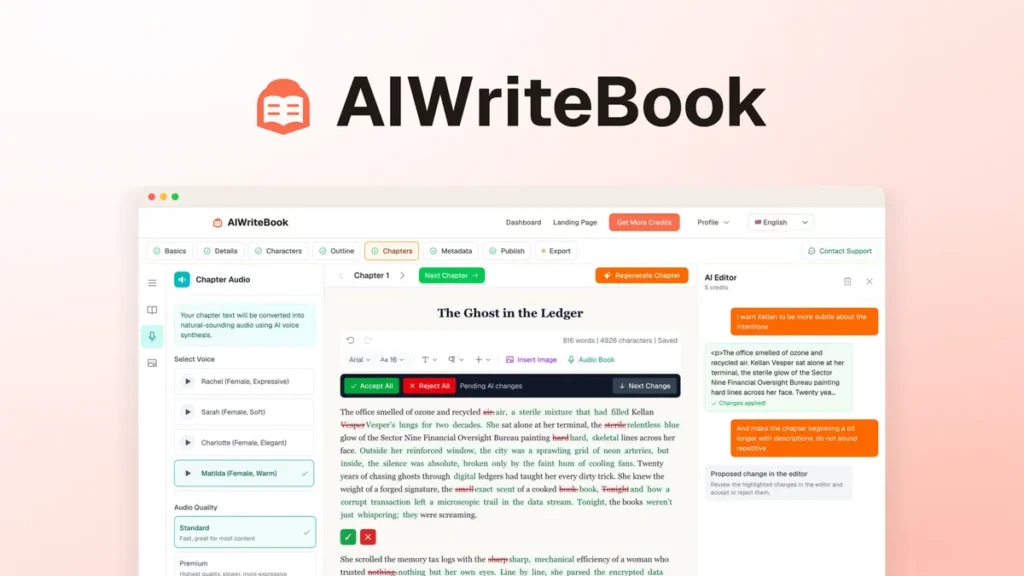
The best AIWriteBook alternative depends on what you actually need: a finished draft fast, a place to organize your own writing, or help with fiction. This guide compares Scrivener, Jasper, Sudowrite, Atticus and a general chatbot (ChatGPT or Claude) against AIWriteBook, using what each tool is built to do.
Disclosure: we tested AIWriteBook ourselves on an account the vendor provided. We built a 96-page book and measured every credit. Read the full hands-on review. The other tools below are described from their stated purpose, not from our own testing, and this page contains affiliate links. See our affiliate disclosure.
Quick answer: which tool for which job
- You want a complete non-fiction draft plus EPUB and print PDF: AIWriteBook.
- You write every word yourself and need organization: Scrivener.
- You draft fiction with AI help: Sudowrite.
- You already have a manuscript and need it formatted: Atticus.
- You write marketing and business content with a team: Jasper.
- You want flexibility and will assemble the book yourself: ChatGPT or Claude.
AIWriteBook alternatives compared
| Tool | Main job | AI drafting | Book export | Best for |
|---|---|---|---|---|
| AIWriteBook | Draft and format a book | Yes, chapter by chapter | EPUB, print PDF, DOCX | Non-fiction and KDP publishers |
| Scrivener | Organize your own manuscript | No | Compile to several formats | Authors who write by hand |
| Sudowrite | Fiction drafting and rewriting | Yes | Not its focus | Novelists |
| Atticus | Format a finished manuscript | Not its focus | EPUB and print | Authors with a finished draft |
| Jasper | Marketing and business content | Yes | Not its focus | Content teams |
| ChatGPT / Claude | General assistant | Yes | Copy into a document | Flexible, DIY workflows |
What AIWriteBook does, from our own test
In our test (8 October 2026), a 10-chapter, roughly 29,000-word non-fiction book came out as 96 typeset pages and cost 365 credits. Each chapter cost 15 credits with Gemini or 30 with Claude. Unlocking formatting costs 200 credits per book, and translating a whole book costs 180. The audiobook feature was the big credit sink at 3,937 credits during the beta.
The finding that matters most: the draft contained confident figures with no sources. Plan to edit and fact-check it as you would a human ghostwriter’s work. The lifetime deal is listed at $79 on AppSumo; check the live page for current terms before buying.
1. Scrivener: best for authors who write every word
Scrivener is a long-form writing environment, not an AI generator. It is known for breaking a project into chapters and scenes, keeping research and notes beside the draft, and compiling the result into several formats. Choose it if you want full control of the prose. It will not write chapters for you.
Where AIWriteBook is different: it generates the draft and the book files. Where Scrivener is better: deep organization for complex projects.
2. Sudowrite: best for fiction drafting with AI
Sudowrite is aimed at fiction writers who want AI help with drafting, rewriting and getting unstuck. If your project is a novel, a fiction-first tool will usually fit better than a non-fiction book generator. Check Sudowrite’s current plans and credit limits on its own pricing page before committing.
3. Atticus: best for formatting a finished manuscript
Atticus is built for formatting books for print and ebook. It suits authors who already have a draft from any source. If you write elsewhere and only need clean interior formatting, Atticus covers that step. It is not a drafting engine.
4. Jasper: best for marketing and business content
Jasper is a general AI writing platform for marketing and business content. It is built for teams producing blog posts, ads and campaigns, so it is a weaker fit for a full book than a tool designed for books. We list it because people searching for AIWriteBook alternatives often compare it.
5. ChatGPT or Claude: best flexible alternative
A general chatbot can outline, draft and rewrite chapters. The cost is your time: you manage consistency between chapters, build the structure, and format the files yourself. This route works well for short books and for authors who like to control each prompt.
Which should you choose?
| If you… | Pick |
|---|---|
| Want a finished, formatted non-fiction draft quickly | AIWriteBook |
| Want to write it all yourself | Scrivener |
| Write novels and want AI help | Sudowrite |
| Have a draft and need formatting only | Atticus |
| Produce content for clients or a team | Jasper |
| Want full control and will do the assembly | ChatGPT or Claude |
Bottom line
AIWriteBook is the closest match if you want AI to produce a whole non-fiction manuscript and the export files in one place. If you value control over speed, or you write fiction, one of the other tools will probably suit you better. Whichever you choose, fact-check everything before publishing.
Frequently asked questions
Is there a free alternative to AIWriteBook?
Yes. A general AI chatbot such as ChatGPT or Claude can draft chapters on a free tier, but you handle structure, consistency and formatting yourself. Free tiers change often, so check each provider’s current limits.
Which alternative is best for fiction?
Sudowrite is built around fiction drafting and rewriting. Scrivener suits writers who want to write every word themselves and need strong project organization.
Do I need AIWriteBook if I already use Scrivener?
Not necessarily. Scrivener organizes a manuscript you write. AIWriteBook generates a draft and exports EPUB and print PDF. Some authors draft with AI, then edit in a writing app.
Can any of these tools publish directly to Amazon KDP?
None of the tools in this comparison uploads to KDP for you. They help you produce the manuscript and files. You upload them in your own KDP account.
Is AI-written non-fiction safe to publish as it is?
No. In our AIWriteBook test, the draft contained confident figures with no sources. Fact-check every number and claim before publishing, whichever tool you use.