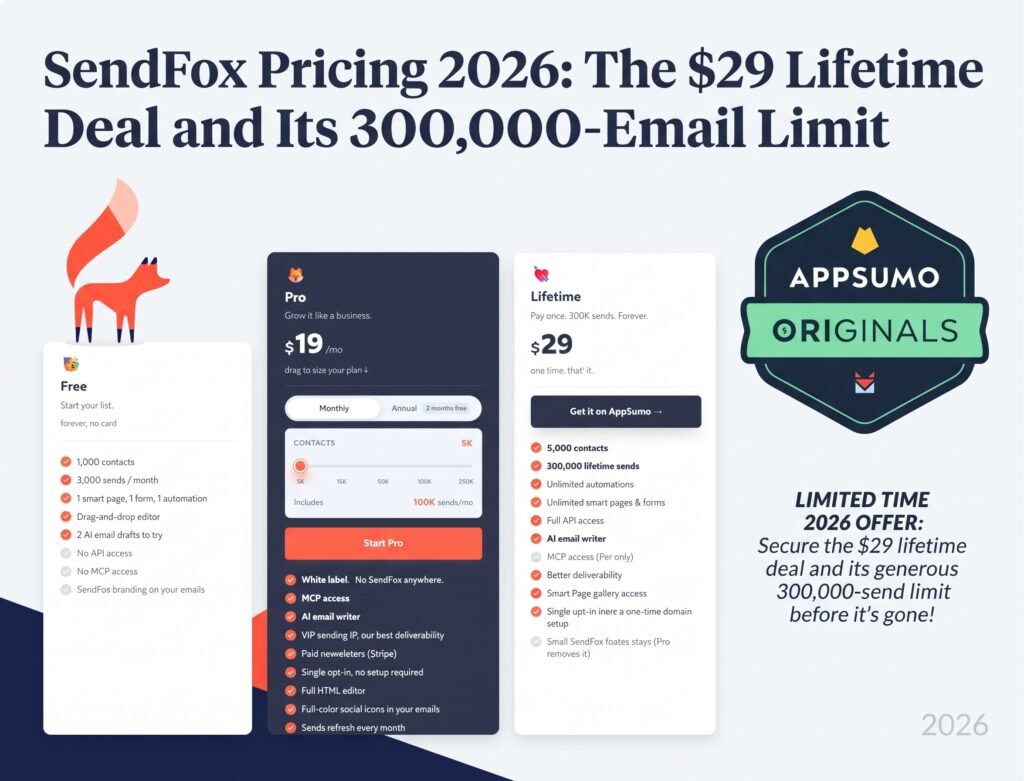

SendFox costs $29 once. Mailchimp’s Essentials plan starts at $13 a month. On a calculator that comparison is over in four months, which is why most articles on this subject stop there.
It is also why most of them are useless. SendFox’s lifetime plan has three limits that decide whether it works for you, and one rule about what you are allowed to send that will disqualify a meaningful number of people reading this. Here is the honest comparison.
The short version
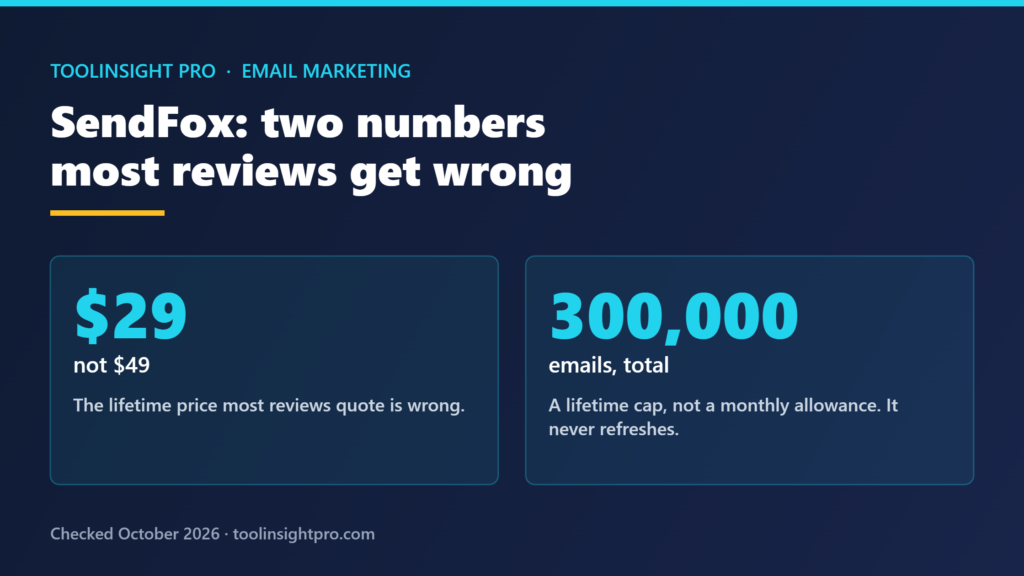
- SendFox’s 300,000 email sends are a lifetime total, not monthly. They never refresh. This is the single most misreported fact about the deal.
- Contact limit is 5,000. At 5,000 contacts, 300,000 sends works out at 60 emails per contact — ever.
- SendFox prohibits low-quality affiliate emails. If affiliate offers are your main send, read the section below before buying anything.
- Double opt-in is mandatory on lifetime accounts, and switching it off requires the $10-a-month Empire add-on.
- Mailchimp’s free plan is 250 contacts with a cap of 500 emails a month or 250 a day, and sending pauses when you exceed it.
Side by side
| SendFox lifetime | Mailchimp free | Mailchimp Essentials | |
|---|---|---|---|
| Cost | $29 once | $0 | From $13/mo for 12 months |
| Contacts | 5,000 | 250 | Scales with plan |
| Email sends | 300,000 lifetime | 500/mo or 250/day | 10x contacts per month |
| Automations | Unlimited triggered | Limited | Available |
| Landing pages | Unlimited | Available | Available |
| Forms | Unlimited | Available | Available |
| API access | Included | Available | Available |
| Branding removed | No — $10/mo add-on | No | Yes |
| Advanced HTML editor | No — $10/mo add-on | — | Yes |
| Disable double opt-in | No — $10/mo add-on | Yes | Yes |
The 300,000 sends, explained properly
SendFox’s listing labels this row “Lifetime email sends: 300,000”. The word doing the work is lifetime. It is not 300,000 a month and not 300,000 a year. It is 300,000 emails in total, after which the allowance is spent.
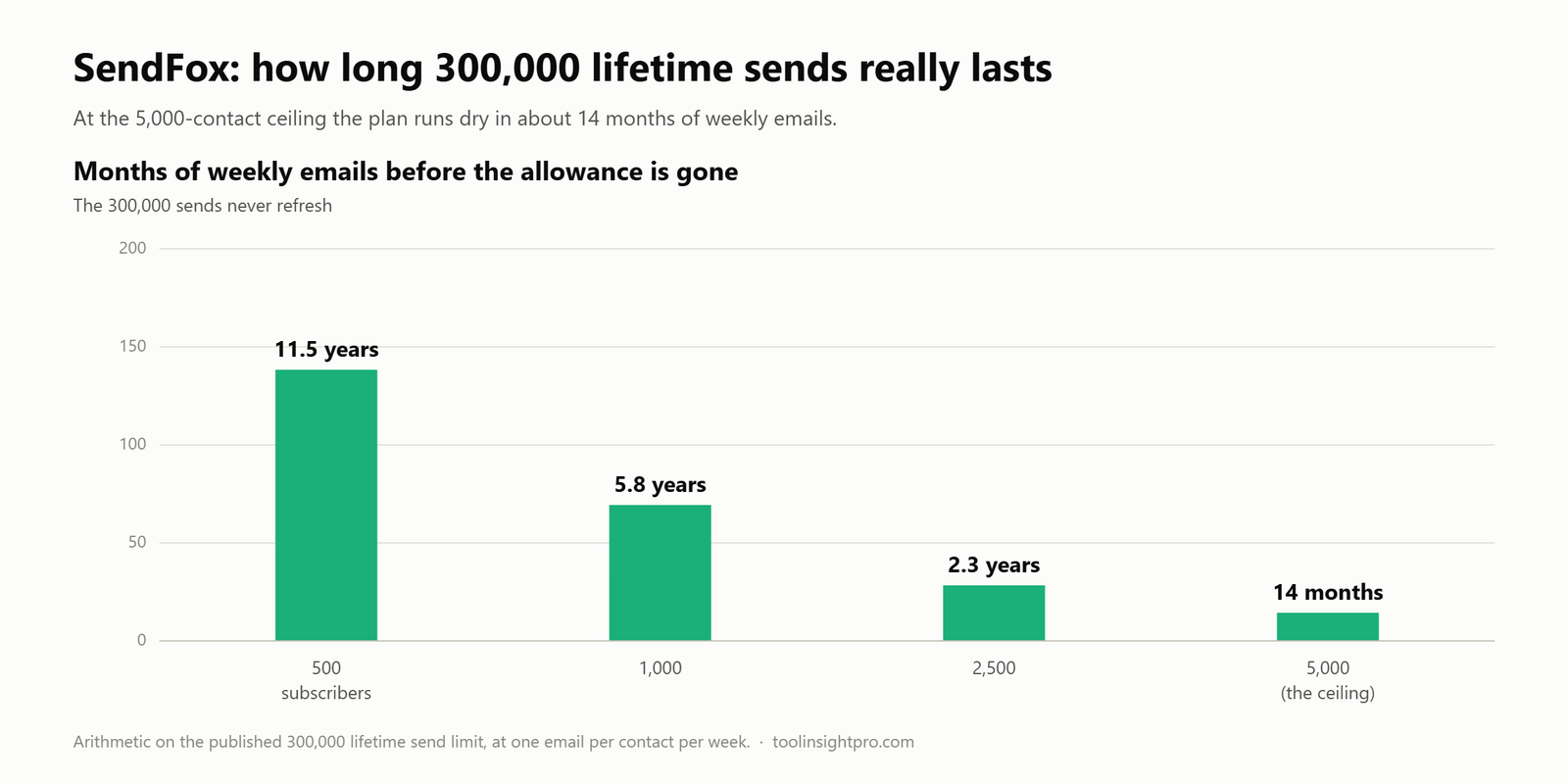
Here is what that means at different list sizes, assuming one email a week:
| List size | Sends per weekly email | How long 300,000 lasts |
|---|---|---|
| 500 | 500 | About 11 years |
| 1,000 | 1,000 | About 5 years 9 months |
| 2,500 | 2,500 | About 2 years 4 months |
| 5,000 | 5,000 | About 14 months |
So the honest reading is this: SendFox’s lifetime plan is excellent if your list stays under about 1,500, and temporary if you grow to the 5,000 contact ceiling. At the maximum list size the plan allows, the send allowance runs out in a little over a year of weekly emails.
That is not a scandal — $29 for 300,000 emails is still cheap by any measure, and plenty of newsletters never reach 1,000 subscribers. But “lifetime” in the plan name and “lifetime” in the send limit mean two different things, and the second one is the one that governs.
The affiliate email rule
This section is here because a lot of people buy cheap email tools specifically to send affiliate offers, and SendFox’s own listing addresses it directly. Low-quality affiliate emails and offers are listed among the things not allowed.
SendFox’s stated reason is deliverability rather than squeamishness: Gmail treats affiliate-heavy bulk mail harshly, and it has a section of its own bulk sender guidelines addressing it. A shared-IP sender cannot afford one account’s affiliate blasts damaging everyone else’s placement, so the policy is self-interest, and reasonable self-interest at that.
The practical reading: a newsletter that recommends tools and occasionally links to them is normal publishing and is not what that rule targets. A list bought or built for the purpose of pushing offers is. If your sending sits closer to the second description, buying SendFox is a bad idea regardless of the price, because the account is the thing at risk.
Mailchimp’s own acceptable use policy is at least as strict on this. There is no cheap platform that solves this problem — it is a Gmail problem, not a vendor problem.
The three things that cost $10 a month
SendFox sells an Empire add-on at $10 per month. The lifetime plan is genuinely one-time, but these three things sit behind that subscription:
- Branding removal. The lifetime plan’s landing pages and forms are branded. The listing describes them as “branded landing pages and forms” in its own summary.
- Advanced HTML editor. Lifetime accounts get the basic HTML editor; full design control is an add-on feature.
- Disabling double opt-in. All lifetime accounts require double opt-in. To skip confirmation for contacts added via the API or a form, you need the add-on.
The double opt-in one deserves attention if you were planning to use the API. Adding a contact programmatically still sends them a confirmation email they have to click, which means your signup-to-subscriber conversion takes a hit you did not plan for. On Mailchimp, single opt-in is a setting.
At $10 a month the add-on costs $120 a year, which reframes the comparison: SendFox plus Empire is roughly Mailchimp Essentials money. SendFox only stays dramatically cheaper if you can live with branding, a basic editor and mandatory double opt-in.
Where Mailchimp’s free plan actually lands
Mailchimp’s free tier is often waved away, so it is worth being precise. Its published pricing allows 250 contacts, and the send cap is listed as a maximum of 500 a month or 250 a day. Exceed either the contact or email limit and sending pauses.
Five hundred emails a month against 250 contacts is two sends per contact per month. That is a fortnightly newsletter to 250 people, and nothing more. For a brand-new list it is survivable; it is not a plan you build on.
For context: SendFox’s $29 covers 5,000 contacts and 300,000 sends. Against Mailchimp’s free tier that is not a close contest.
Who should buy which
SendFox makes sense if
- Your list is under roughly 1,500 and growing slowly. The send allowance will outlast your interest in the project.
- You are a creator, podcaster or blogger sending a newsletter, which is exactly who it was designed for.
- You can tolerate SendFox branding, or the $10 add-on is still cheaper than your alternative.
- You want unlimited automations, forms and landing pages without a monthly bill. These are genuinely unlimited at $29.
- You want API access without an upgrade. It is included.
Mailchimp makes sense if
- You expect to pass 5,000 contacts, which SendFox’s lifetime plan cannot hold.
- You send frequently — several emails a week to a few thousand people exhausts 300,000 quickly.
- You need single opt-in, advanced email design, or unbranded output without a recurring add-on.
- You need e-commerce integrations, segmentation depth or reporting that a $29 tool was never built to provide.
What I could not verify
- Mailchimp’s exact price at 5,000 contacts. Its pricing page uses a contact selector and does not publish per-tier figures in the page text. The $13 Essentials figure is the published starting point, for 12 months, and your actual cost will be higher at a list of that size. I am not going to estimate it.
- What happens when SendFox’s 300,000 sends run out. The listing does not say whether you can buy more, must upgrade, or simply stop. Ask before you buy if you expect to reach it.
- Whether the 5,000 contact limit counts unsubscribed contacts. Not stated, and it materially changes how long the plan lasts.
- Deliverability in your hands. SendFox reports a “High” rating on all its sending IPs and the default sending domain, and says more than 35 million emails a month go through it. That is their figure, and your own results depend on your list and your content more than on either platform.
- The $480 regular price anchoring SendFox’s 94% discount. That is AppSumo’s own figure.
Frequently asked questions
Is SendFox really a one-time payment?
The plan is, at $29 once with all future lifetime plan updates. But branding removal, the advanced editor and disabling double opt-in sit behind the $10-a-month Empire add-on, so “no recurring cost” is only true if you do not need those three things.
Is SendFox better than Mailchimp?
For a small newsletter under about 1,500 subscribers, SendFox is better value by a wide margin and does everything that use case needs. Above 5,000 contacts the question does not arise, because SendFox’s lifetime plan cannot hold your list.
How many emails can I send with SendFox?
300,000 in total, for the lifetime of the account. Not per month.
Can I move my list from Mailchimp to SendFox?
SendFox supports importing contacts, and the lifetime plan includes API access. The thing to plan for is double opt-in: on a lifetime account it is mandatory, so imported or API-added contacts get a confirmation email. Confirm the behaviour for bulk imports with SendFox before migrating a list you care about.
Does SendFox allow affiliate marketing emails?
Low-quality affiliate emails and offers are not allowed. A newsletter that recommends products as part of genuine editorial content is a different thing from a list built to push offers. If your sending is mostly the latter, SendFox is not the right platform, and neither is Mailchimp.
Who makes SendFox?
AppSumo. It is an AppSumo Original, founded in September 2018, based in Texas with a team of one to ten. The listing says more than 195,000 creators have sent over 2 billion emails through it.
Verdict
SendFox at $29 beats Mailchimp’s free plan comprehensively and beats Mailchimp Essentials on cost for anyone with a small, slow-growing list. Unlimited automations, forms and landing pages plus API access at that price is not something Mailchimp will match.
The two reasons to choose Mailchimp instead are size and frequency. Five thousand contacts is a hard ceiling, and 300,000 lifetime sends is a soft one that arrives sooner than people expect. If you are building toward a large list or you email several times a week, you will be paying someone monthly eventually — and starting on the platform you will end on saves a migration.
Buy SendFox for a newsletter. Do not buy it as an escape from ever paying for email.
Check the current SendFox plan and limits on AppSumo, or read our SendFox pricing breakdown for the full tier detail.
Related reading
- SendFox pricing explained
- Reoon Email Verifier review — clean your list before you spend sends on addresses that bounce
- SalesBlink review — for cold outreach, which is a different job from newsletters
- SocialBu review — social scheduling alongside your newsletter
How this was researched: SendFox figures come from its AppSumo listing, deal terms and published FAQ; Mailchimp figures from its own marketing pricing page. Both were read in October 2026. This is desk research against primary sources, not hands-on testing — I have not sent campaigns through either platform for this comparison, and the send-duration table is arithmetic on published limits rather than measured results. Where a figure could not be confirmed I have said so. See our review methodology and editorial policy.
Disclosure: AppSumo links in this article are affiliate links. Your price is unchanged and ToolInsight Pro may earn a commission. Mailchimp links are not affiliate links.