
Tiers and limits taken from the Inrō AppSumo listing, checked 21 October 2026.
Instagram DM automation tools are usually metered by contacts rather than by messages. Inrō counts “contacts activated per month”, which means a person who writes to you once and a person who exchanges thirty messages both cost the same single unit.
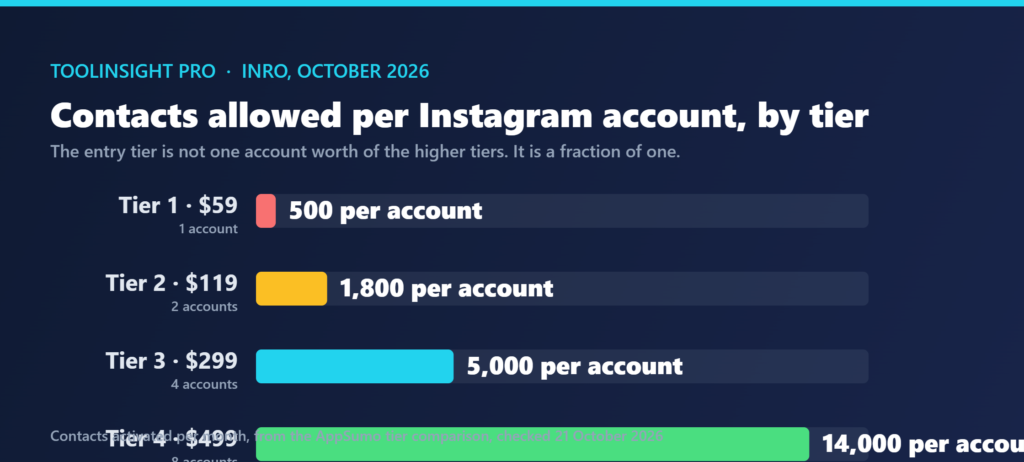
That unit is what decides which tier fits, and the entry tier is tighter than it looks: 500 contacts a month against 14,000 per account at the top.
The short version
- The meter is contacts activated per month, not DMs sent or replies generated.
- Per account, allowances run 500, 1,800, 5,000 and 14,000 across the four tiers.
- Measured as licence price per monthly contact, the entry tier costs roughly 26 times what the top tier does.
- A unified dashboard is listed as available in tier 4 and above, so multi-account users on lower tiers switch between accounts.
Why the contact meter changes the sums
Message-based pricing rewards short conversations. Contact-based pricing does the opposite: once a person is counted, the rest of the conversation is free. A tool that opens with a question and runs a long thread suits this meter well. A tool that fires a single automated reply to every comment burns a contact for each one.
That makes the useful question not how many DMs you send but how many distinct people write to you in a month. Comment-reply automation is where the two diverge most, because a viral post can produce hundreds of one-line interactions, each consuming a contact.
The four tiers, read per account
Totals on a tier table flatter the higher tiers, because they bundle more accounts. Dividing by the account count shows what each Instagram profile actually gets.
| Tier | Price | Instagram accounts | Contacts a month | Per account | AI credits a month | Per account | Team seats |
|---|---|---|---|---|---|---|---|
| 1 Creator | $59 | 1 | 500 | 500 | 200 | 200 | 1 |
| 2 Creator Pro | $119 | 2 | 3,600 | 1,800 | 1,400 | 700 | 3 |
| 3 Business | $299 | 4 | 20,000 | 5,000 | 8,000 | 2,000 | 5 |
| 4 Scale | $499 | 8 | 112,000 | 14,000 | 40,000 | 5,000 | 10 |
Tier 1 is the outlier. Moving to Tier 2 doubles the accounts and multiplies contacts by 7.2, so the per-account allowance more than triples for roughly double the price. Every later step repeats the pattern at a smaller scale.
A fifth tier at $799 is listed as Agency, with no limits published on the comparison table.
What a contact costs at each tier
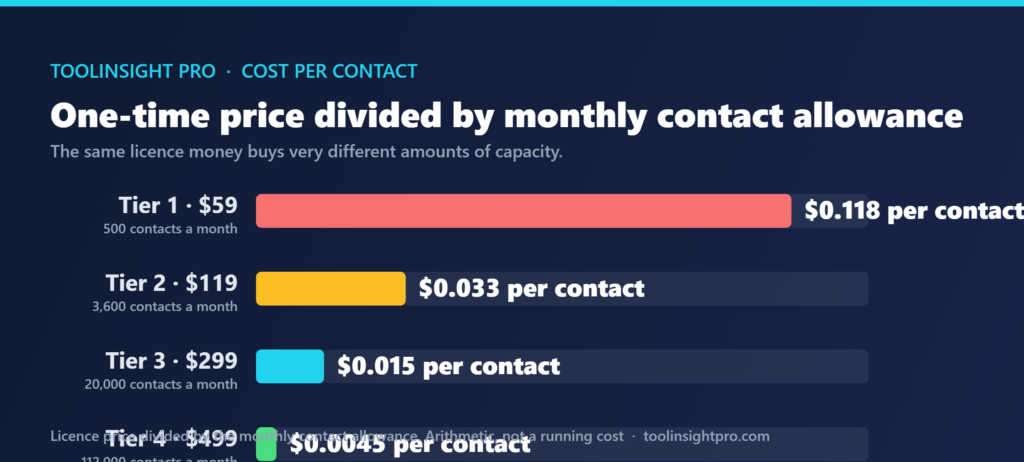
Dividing the one-time price by the monthly contact allowance gives a rough measure of what the licence buys. It is arithmetic rather than a running cost, since nothing recurs after purchase.
| Tier | Price | Contacts a month | Price per monthly contact |
|---|---|---|---|
| 1 | $59 | 500 | $0.118 |
| 2 | $119 | 3,600 | $0.033 |
| 3 | $299 | 20,000 | $0.015 |
| 4 | $499 | 112,000 | $0.0045 |
Spread over a long enough period the one-time price stops mattering and the ceiling is what counts. For a single creator answering a few hundred people a month, Tier 1 is adequate and the per-contact figure is irrelevant. For anyone expecting growth, the gap between 500 and 1,800 contacts per account is the one to plan around, because the allowance is monthly and does not roll over as far as the listing says.
Three things the listing does not settle
What counts as activation. The term is “contacts activated per month”, which suggests a contact is counted when the automation first engages them. Whether a returning contact counts again the following month is not stated, and on a repeat audience that difference is large.
Which tiers include which features. The feature rows for the AI agent, Meta Conversions API, bring-your-own-key and unlimited automations carry no per-tier values on the listing. Only the unified dashboard is pinned, to tier 4 and above.
What happens at the ceiling. The listing does not say whether automations stop, queue, or continue uncounted once the monthly allowance is spent. On a tool answering customers, the difference between stopping and queueing matters.
All three are refund-window questions. The licence must be activated within 60 days of purchase, and the deal is refundable for 60 days.
Frequently asked questions
How is Instagram DM automation usually priced?
By contacts rather than messages. Inrō meters contacts activated per month, so one person sending thirty messages costs the same as one sending a single message. Check which unit a tool counts before comparing prices across vendors.
How many contacts does the $59 Inrō tier allow?
500 a month on one Instagram account, with 200 AI credits and one team seat. The $119 tier allows 3,600 contacts across two accounts, which works out at 1,800 per account rather than 500.
Does the allowance roll over?
No. The allowances are stated per month. The listing does not describe any carry-over of unused contacts or AI credits, so a quiet month does not build capacity for a busy one.
Can I run several Instagram accounts from one screen?
Only on the higher tiers. The listing pins a unified dashboard to tier 4 and above. On tiers 2 and 3 you have multiple accounts without a single view of them, which is worth knowing before buying for an agency.
Is comment-reply automation counted differently from DMs?
The listing does not separate them, which matters because comment replies generate many short interactions. If each commenter counts as a contact, a single popular post can consume a large share of a monthly allowance.
Bottom line
Count the people who message you in a month, not the messages, then read the per-account column rather than the tier total. Tier 1 suits one creator with modest volume, and anyone past a few hundred contacts should look at Tier 2 before buying.
Related reading
- What AppSumo Listings Leave Out: nine limits documented in vendor sources rather than on deal pages.
- Subscription vs One-Time License: how to work out whether a one-time price beats paying monthly.
- SocialBu Review: another social tool where the entry tier excludes the automation most buyers want.