
Tiers and rates taken from the EzyCommunity AppSumo listing, checked 21 October 2026.
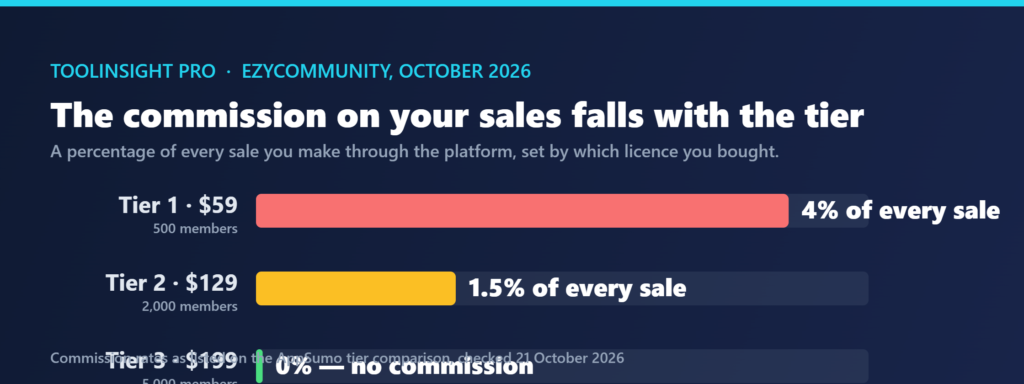
An online community platform sold as a one-time licence can still keep a percentage of what you sell through it. EzyCommunity charges 4% of every sale on its $59 tier, 1.5% on the $129 tier and nothing on the $199 tier. That percentage, rather than the licence price, decides the real cost.
Past roughly $3,500 of cumulative sales, the $199 tier has cost less than the $59 one.
The short version
- Commission is charged per sale and falls with the tier: 4%, then 1.5%, then 0%.
- The break-even between the cheapest and dearest tier is $3,500 of cumulative sales, not monthly sales.
- Members, courses, marketing emails, storage and “database operations” are all metered separately.
- The listing contradicts itself twice, on white-label branding and on the weekly email digest.
Why the commission matters more than the sticker price
A one-time licence is usually compared against a monthly subscription, and that comparison is easy. A commission is harder, because it has no fixed size. It grows with the thing you are trying to grow.
On a community selling courses or memberships, 4% of revenue is the line that keeps charging after the licence is paid for. Selling $10,000 of courses over two years on the $59 tier costs $400 in commission, which is nearly seven times the licence.
| Tier | Price | Members | Courses | Marketing emails a month | Database operations a month | Storage | Commission per sale |
|---|---|---|---|---|---|---|---|
| Tier 1 | $59 | 500 | 5 | 1,000 | 50,000 | 5GB | 4% |
| Tier 2 | $129 | 2,000 | 10 | 1,500 | 130,000 | 10GB | 1.5% |
| Tier 3 | $199 | 5,000 | 15 | 5,000 | 150,000 | 15GB | 0% |
Read across rather than down. Members multiply by ten between the cheapest and dearest tier, marketing emails by five, storage by three, and the commission goes to zero. Those four scales move at different rates, so the tier that fits your member count may not be the tier that fits your sales.
When an upgrade costs less than staying put
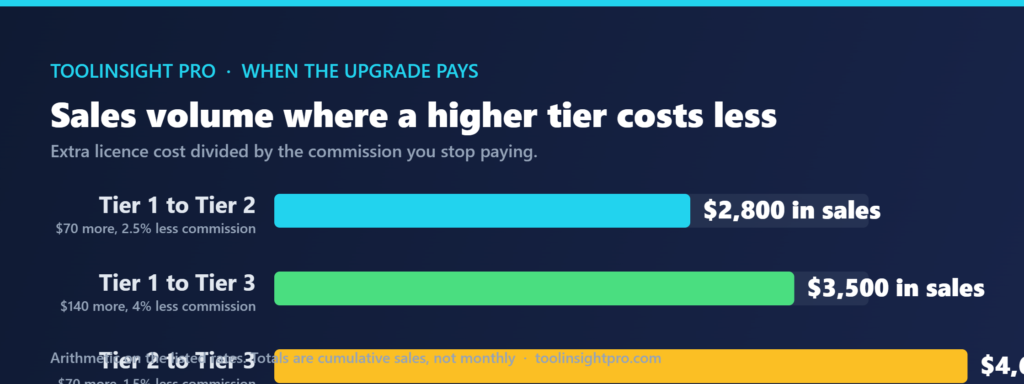
The arithmetic is the extra licence cost divided by the commission you stop paying.
| Upgrade | Extra licence cost | Commission saved | Break-even in cumulative sales |
|---|---|---|---|
| Tier 1 to Tier 2 | $70 | 2.5 percentage points | $2,800 |
| Tier 1 to Tier 3 | $140 | 4 percentage points | $3,500 |
| Tier 2 to Tier 3 | $70 | 1.5 percentage points | $4,667 |
These are cumulative figures rather than monthly ones, which is what makes them modest. A community that sells $300 of memberships a month crosses $3,500 inside a year, and everything after that is saving. A free community that never sells anything pays no commission at any tier, so the cheapest licence is the right one.
The jump from Tier 2 to Tier 3 is the weakest of the three. It costs the same $70 as the first upgrade but saves only 1.5 percentage points, so it needs $4,667 of sales to justify itself. Going straight from Tier 1 to Tier 3 is better value than arriving there in two steps.
The limits that are easy to miss
Three of the metered figures deserve a closer look before buying.
Database operations. Capped at 50,000 a month on Tier 1 and 150,000 on Tier 3. The listing never defines what counts as one. Whether a member loading a feed costs one operation or twenty changes what that cap means, and the difference is the whole question.
Marketing emails. 1,000 a month on Tier 1. A community of 500 members can send that allowance in two newsletters, so the member cap and the email cap do not sit comfortably together.
Storage. 5GB on Tier 1. Courses with video consume that quickly, and the listing does not say what happens when the limit is reached.
Two places where the listing contradicts itself
Both are worth settling with the vendor inside the refund window, because both affect which tier you should buy.
White-label branding appears in the feature section as available in Tier 3. It does not appear on the tier comparison cards at all.
The weekly community email digest is listed on the tier cards for all three tiers, while the feature section describes it as a Tier 3 item.
Neither is unusual on a new listing, and neither suggests bad faith. They do mean the tier table alone is not enough to decide on. The habit of reading vendor documentation against the deal page is the one that catches this sort of thing, and more examples are collected in our piece on what AppSumo listings leave out.
Frequently asked questions
Do online community platforms charge commission on sales?
Some do. EzyCommunity’s AppSumo tiers list 4% at $59, 1.5% at $129 and 0% at $199. Check the tier comparison rather than the headline price, because a commission line is easy to miss and scales with your revenue.
When is the $199 tier cheaper than the $59 one?
Past $3,500 of cumulative sales. The upgrade costs $140 more and removes a 4% commission, so the arithmetic is $140 divided by 0.04. Below that figure the cheaper licence wins, above it the dearer one does.
How many members does the $59 tier allow?
500 members, with 5 courses, 1,000 marketing emails a month, 50,000 database operations a month and 5GB of storage. The $129 tier raises members to 2,000 and the $199 tier to 5,000, with storage rising to 15GB.
What is a database operation?
The listing does not say. It caps them at 50,000 a month on the $59 tier, rising to 150,000 on the $199 tier, without defining what counts as one. Ask the vendor before the 60-day refund window closes.
Is white-label branding included?
Only at Tier 3, according to the feature section. The tier comparison cards do not list it at all, which is one of two places where the listing contradicts itself. Confirm it in writing before relying on it for client work.
Bottom line
Pick the tier by your expected sales rather than your member count. Anything past $3,500 of cumulative revenue makes the $199 licence the cheaper one, and a community that never sells should stay on the $59.
Related reading
- What AppSumo Listings Leave Out: nine limits documented in vendor sources rather than on deal pages.
- Subscription vs One-Time License: the break-even method applied to monthly pricing.
- The Economics of SaaS Lifetime Deals: why a vendor charges commission on a one-time licence at all.