
Someone with 20,000 subscribers and someone with 2,000 can send the same campaign and see very different results. The larger list often does worse. The cause is not size on its own. It is what mailbox providers measure, and they measure rates rather than totals.
The short version
A small list where most people still open your mail will usually reach the inbox more reliably than a large list where most people stopped reading a year ago. Gmail judges you on the percentage of recipients who mark you as spam, not on how many you sent to. Adding dormant contacts raises the numerator and the denominator together, and the dormant ones are the group most likely to complain.
Gmail measures rates, so volume buys you nothing
Google and Yahoo introduced a shared set of sender rules in February 2024. Send 5,000 or more messages a day to Gmail addresses and you have to authenticate with SPF, DKIM and DMARC, offer one-click unsubscribe, and keep spam complaints below 0.3%. Google’s own guidance names 0.1% as the level to work at rather than the level to survive at.
The figure that matters is a rate. That has one consequence people miss: a bigger list does not give you more room, because the limit moves with you. It gives you more people who could push you over.
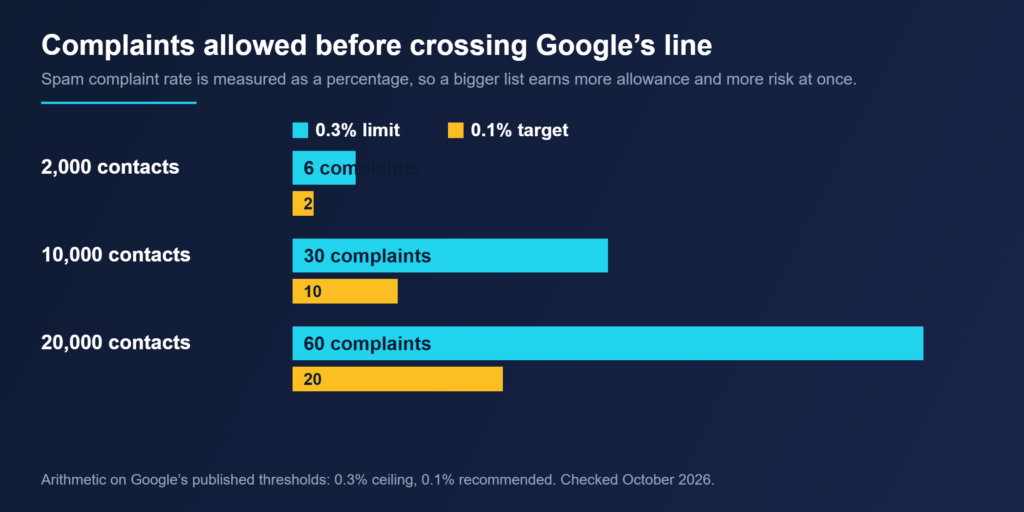
What the allowance looks like at three list sizes
The arithmetic is simple enough to do in your head, and worth doing once so the numbers stop feeling abstract.
| Contacts on the send | Complaints at the 0.3% ceiling | Complaints at the 0.1% target |
|---|---|---|
| 2,000 | 6 | 2 |
| 10,000 | 30 | 10 |
| 20,000 | 60 | 20 |
| 50,000 | 150 | 50 |
Twenty thousand contacts sounds like it comes with ten times the safety margin of two thousand. It comes with ten times the opportunities to be reported instead.
Why the dormant half does the damage
Complaints are not spread evenly across a list. They cluster among people who forgot they subscribed. Somebody who opened your last three emails is unlikely to press the spam button on the fourth. Somebody who last opened in 2024 has no memory of you, and the spam button is closer than the unsubscribe link.
Dormant addresses carry a second problem. Mailbox providers reclaim abandoned accounts and some are turned into spam traps, which exist to catch senders who never clean their lists. A list that has not been pruned collects these quietly, and you cannot see them from your side. The only defence is not mailing addresses that have gone silent for a long time.
There is a third effect that surprises people. Reputation attaches to your sending domain, not to the campaign. Mail sent to the dormant half damages delivery for the engaged half, because both go out under the same domain. The good list does not sit in a separate compartment.
The cut that usually pays for itself
Here is a worked example. The complaint counts below are illustrative, chosen to show how the rate moves. The percentages are arithmetic on those counts.
| Who you send to | Complaints in that send | Resulting rate | Against the 0.3% ceiling |
|---|---|---|---|
| All 20,000 | 45 | 0.225% | Under, with little room |
| All 20,000 | 65 | 0.325% | Over |
| 4,000 engaged only | 5 | 0.125% | Under, with room |
The third row is the one to sit with. Sending to one fifth of the list produced a rate well inside Google’s recommended level, because the people most likely to complain were not on the send. Revenue from a campaign comes from people who read it. Removing people who do not read it costs less than it looks.
When keeping the large list is the right call
Cutting is not always correct. A list that looks dormant may simply have never been mailed, which is a different problem with a different fix. If you bought a business and inherited its subscribers, or you have not sent anything in eight months, low engagement tells you nothing about the people on it yet.
Seasonal businesses are the other case. A customer who buys once a year in November is not dormant in June. Judging engagement on a rolling 90 days would remove your best buyers.
In both situations the answer is to send to a small slice first, watch what happens, and widen only if the numbers hold. That is a different decision from mailing everyone and hoping.
Frequently asked questions
Does a smaller list mean less revenue?
Not usually. Revenue comes from people who open and click. Removing contacts who do neither changes your reported open rate more than it changes your sales, and it protects delivery to the people who do buy.
How many complaints is too many?
Google draws the line at 0.3% and recommends working at 0.1%. On a 10,000 contact send that is 30 complaints at the ceiling and 10 at the recommended level. The rate is measured by Google, not by your sending platform.
Can I just send less often to the big list?
Sending less often reduces how quickly damage accumulates, but it does not fix the cause. The dormant contacts still complain at a higher rate whenever you do send, and spam traps still sit on the list.
Is it better to delete or suppress inactive contacts?
Suppress rather than delete. Suppression keeps the record so you do not re-import the same address later, and it leaves the option of a win-back campaign open. Deleting loses the history that tells you why they were removed.
Bottom line
Mailbox providers score you on percentages, so a large list gives you no extra allowance and a larger pool of people who might report you. If most of your contacts stopped opening a year ago, the list is not an asset you are protecting. It is the thing holding your delivery down.
Related reading
- Google’s bulk sender rules: what changes at 5,000 messages a day and what applies below it.
- Hard bounce vs soft bounce: what the SMTP reply code tells you and when to stop retrying.
- What a catch-all address is: why an SMTP check cannot see past one.