
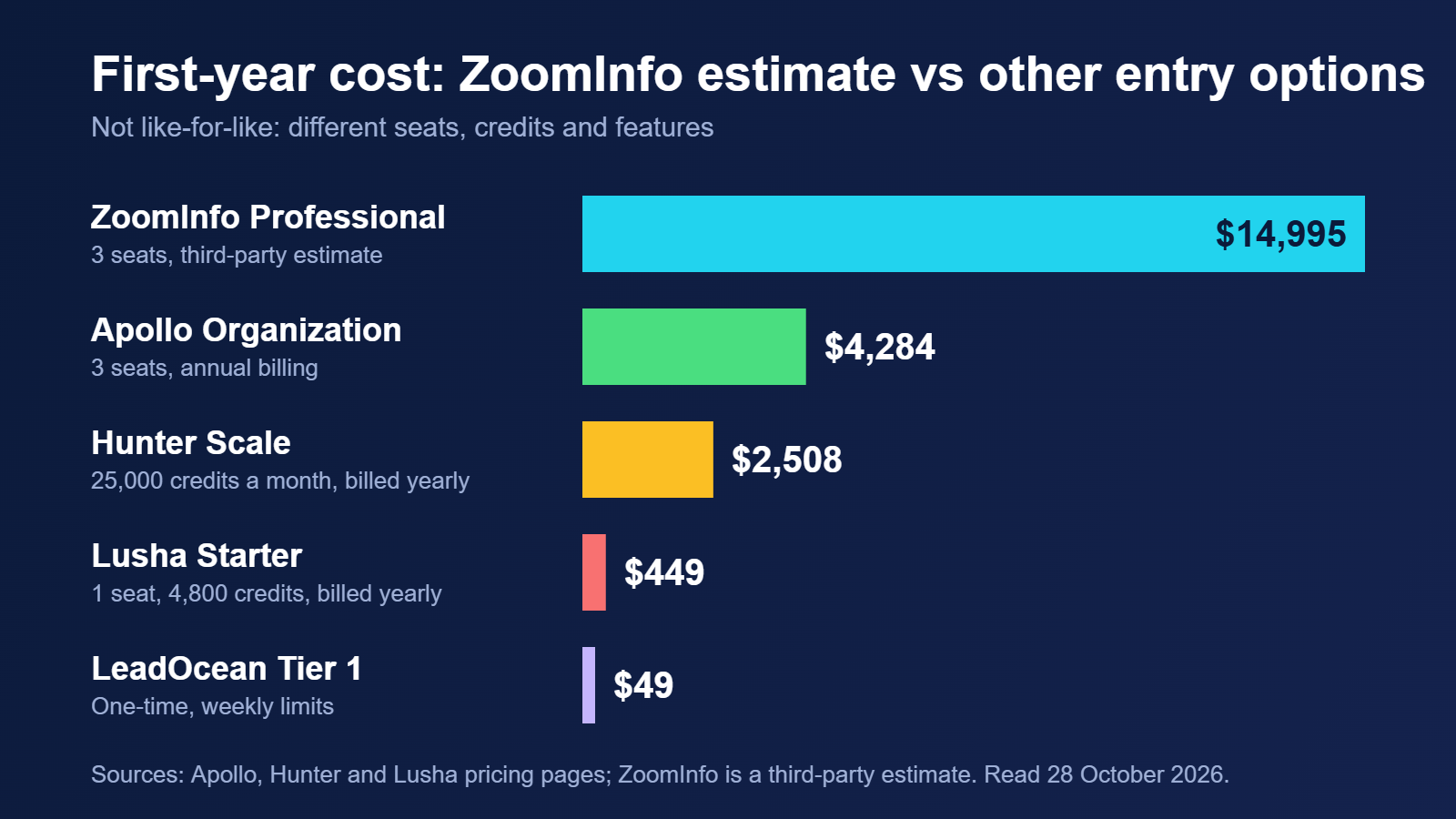
Quick answer: ZoomInfo does not publish prices, and third-party reports put its Professional plan near $14,995 a year on an annual contract with three seats. Alternatives such as Apollo, Hunter, Lusha and LeadOcean start far lower, but each does less or limits usage differently. Choose by the job you need done, then test data quality on your own list.
ZoomInfo is the name most sales teams compare against, mainly because of its size and its price. The company sells through sales reps, so published figures come from buyers and competitors, not from ZoomInfo. This guide sets those reported numbers beside four alternatives whose prices are public, and explains where each one is narrower.
Disclosure: this page contains an affiliate link to AppSumo for the LeadOcean mention, and I may earn a commission if you buy through it. I have not tested any tool here. Prices come from vendor pages and third-party sources read on 28 October 2026, and they change often.
What ZoomInfo reportedly costs
ZoomInfo’s own pricing page lists no prices and says packages are custom, based on features, number of licenses and credit usage. The figures below come from a 2026 blog by Pin, a competing recruiting platform, which cites buyer reports and third-party analyses. They are estimates, not ZoomInfo list prices.
| Plan | Reported annual cost | Seats | Monthly credits | Notes |
|---|---|---|---|---|
| Professional | About $14,995 | 3 | About 5,000 | Contact and company data, basic filters |
| Advanced | $24,995 to $30,000 | 3 to 5 | About 10,000 | 300+ filters, intent data as an add-on |
| Elite | $39,995 and up | 5+ | 15,000 to 20,000 | Intent data and copilot included |
Contract terms to check before signing
The same report describes annual-only contracts, a three-seat minimum on every tier and auto-renewal with a 60 to 90 day cancellation window. It also says renewal increases of 10% to 40% are common, unused credits do not roll over, and overages cost $0.25 to $0.50 per credit. Add-ons are reported separately, such as extra seats at $1,500 to $2,500 per user a year and intent data at $5,000 to $15,000. I cannot confirm any of this, so treat it as a checklist of questions for your sales rep, not as ZoomInfo policy.
ZoomInfo alternatives compared
| Tool | What it costs | What you give up versus ZoomInfo |
|---|---|---|
| Apollo | Free, or $49 to $119 per seat per month on annual billing, with 30,000 to 72,000 credits a year | Plans are for internal use only, and credits are per seat |
| Hunter | Free: 50 credits a month. Paid from $34 a month billed yearly | Email-focused, and the pricing page lists no phone database |
| Lusha | Starter is $37.45 a month billed yearly for 4,800 credits a year | Credit-based; the pricing page does not state credits per reveal |
| LeadOcean | $49 one-time for Tier 1 on AppSumo | Data only, with 5-hour and weekly caps |
Apollo
Apollo is the closest all-in-one comparison. Its pricing page lists Basic at $49 per seat per month on annual billing with 30,000 credits a year, Professional at $79 with 48,000 and Organization at $119 with 72,000 and a three-seat minimum. See our Apollo alternatives guide for the full breakdown.
Hunter
Hunter’s pricing page lists Starter at $34 a month billed yearly for 2,000 credits a month, Growth at $104 for 10,000 and Scale at $209 for 25,000, with a free plan of 50 credits. It is a sensible test if your main need is finding and verifying email addresses.
Lusha
Lusha’s own pricing page, read on 28 October 2026, lists Starter at $37.45 a month billed yearly for 4,800 credits a year, Pro at $52.45 for 7,200 credits, and Premium at $299.95 for 40,800 credits. The page does not say how many credits an email or phone reveal uses, so check that before you buy.
LeadOcean
LeadOcean is the lowest entry price here and also the most limited in scope. AppSumo sells Tier 1 for $49 once, with 20K search records per 5 hours, 100K per week and a 60-day refund window. The company states it is data only, not a CRM or a sequencer. Read our LeadOcean review for the limits and buyer reports, then view the AppSumo listing for current tiers.
Which one should you pick
Large teams that need integrations, support and a negotiated contract are the audience ZoomInfo is built for, so price it properly before switching. Small teams and solo prospectors usually get more from a public price list and a refund window. Run the same 100 contacts from your niche through each trial, verify the emails, and compare bounce rates, as described in our guide to B2B sales email verification techniques.
Frequently asked questions
Does ZoomInfo publish its prices?
No. ZoomInfo’s pricing page says it offers custom packages based on features, number of licenses and credit usage. Third-party reports add annual contracts and a three-seat minimum, and put Professional near $14,995 a year, so request a written quote.
What is the best ZoomInfo alternative for a small team?
It depends on the job. Apollo covers data plus outreach from $49 per seat per month on annual billing, Hunter focuses on emails from $34 a month billed yearly, and LeadOcean sells data only for $49 once with usage caps.
Can I cancel ZoomInfo mid-contract?
Third-party reports describe annual auto-renewing contracts with a 60 to 90 day cancellation window, so mid-term exits are unlikely. Read the order form for notice dates before signing, and put the renewal deadline in your calendar.
Are cheaper ZoomInfo alternatives as accurate?
Nobody can say without testing. One AppSumo buyer reported LeadOcean verified 97% of a 1,000-lead test against 67% for another platform, but that is a single buyer’s claim. Run your own sample list through an email verifier before committing.
Sources: Pin on ZoomInfo pricing, Apollo pricing, Hunter pricing and Lusha pricing, all read on 28 October 2026.