
Quick answer: A B2B lead database sells searchable contact and company records, priced by seat, credit, annual contract or one-time license. Judge one by coverage in your niche, email accuracy and usage limits, not by its headline record count. Before paying, pull about 100 contacts, verify the emails and compare tools on the same sample.
Every lead database advertises a huge number, and most buyers never learn how much of it is usable. This guide explains how the main pricing models differ, why headline size misleads, and how to run a short test on your own niche before you commit money. Examples come from Apollo, Hunter, Lusha, ZoomInfo and LeadOcean.
Disclosure: this page contains an affiliate link to AppSumo for the LeadOcean mention, and I may earn a commission if you buy through it. I have not tested any tool here. Prices come from vendor pages and third-party sources read on 28 October 2026, and they change often.
What a B2B lead database includes
Most databases hold person records (name, title, company, location, work email, sometimes a phone number) and company records (size, industry, location). Vendors separate search from enrichment. LeadOcean describes search as returning a short record and enrichment as pulling the full profile for one person, and both count toward its limits. Other tools use their own terms, so read how each one counts a “credit” or “record”.
Five pricing models
| Model | Example | Reported price | Watch for |
|---|---|---|---|
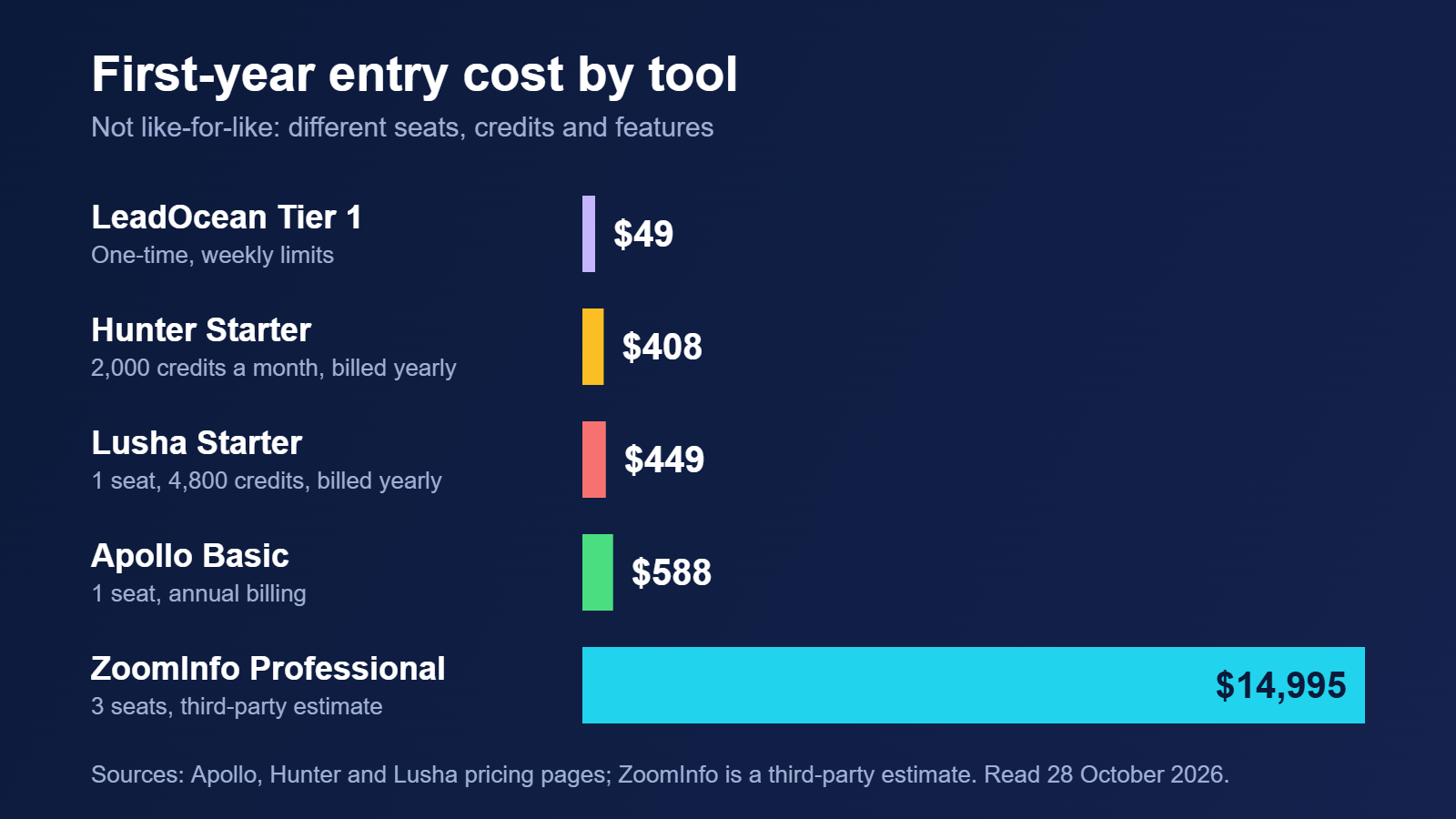
| Per-seat credits | Apollo | Free, or $49 to $119 per seat per month on annual billing | Credits are per seat, and add-on credits renew until removed |
| Monthly credits | Hunter | Free: 50 credits a month. Starter: $34 a month billed yearly for 2,000 credits | Email-focused, and credits cover different actions |
| Per-reveal credits | Lusha | Starter: $37.45 a month billed yearly for 4,800 credits a year | Credit-based; the pricing page does not state credits per reveal |
| Annual contract | ZoomInfo | Quote only. Third-party estimates near $14,995 a year, 3 seats | Auto-renewal and credit overages, per third-party reports |
| Lifetime deal | LeadOcean | $49 one-time for Tier 1 on AppSumo | 5-hour and weekly usage caps |
Headline size is not usable size
LeadOcean claims 693 million people profiles. One buyer testing it with Claude counted about 124.8 million people with an email you can send to, roughly 18% of the total. The founder replied that this counts only verified emails and that roughly 200 million profiles have verified work emails. I cannot verify either number, and the gap shows why you should ask for records with a sendable email in your target region, not the total.
A five-step test before you pay
- Define the niche. Pick one job title and one region you actually sell to.
- Pull a sample. Take about 100 contacts from each candidate tool using a free plan, trial or the refund window.
- Count coverage. Note how many have an email, a phone and a current title.
- Verify the emails. Run them through an email verifier and record the invalid and catch-all share, as covered in our guide to B2B sales email verification techniques.
- Spot-check titles. Check 10 contacts by hand to see how stale the data is, then compare the tools on identical samples.
| Check | How to measure it | Red flag |
|---|---|---|
| Email coverage | Contacts with an email out of the 100 pulled | Far fewer than other tools on the same sample |
| Email validity | Valid, invalid and catch-all share after verification | A high invalid or catch-all share |
| Phone coverage | Contacts with a phone number, if you need calls | Missing for your region or seniority |
| Title accuracy | Manual check of 10 titles against the company site | Several out of date |
| Cost per usable contact | Plan cost divided by contacts that passed verification | Much higher than other tools once credits are counted |
Limits and compliance to check
Read the usage terms. Apollo says its plans are for internal business use only, and AppSumo buyers of LeadOcean found weekly caps that were first missing from the deal page, as covered in AppSumo listing limits that are not on the deal page. Also check where the vendor sources its data and whether it offers a removal request page. Cold email rules such as GDPR and CAN-SPAM differ by country, so this is not legal advice, and a sound sending setup matters too, as in our SPF, DKIM and DMARC explainer.
Which model fits which buyer
Teams that want data and outreach together look at per-seat plans. Solo prospectors who need emails look at monthly-credit tools. Large teams with procurement support look at annual contracts. Buyers who can live with caps and want one payment look at lifetime deals such as LeadOcean, and you can read our LeadOcean review or check the AppSumo listing for the current tiers. Comparisons by tool are in our guides to Apollo, ZoomInfo and Lusha alternatives.
Frequently asked questions
What is a B2B lead database?
It is a searchable collection of business contacts and company records, usually with job titles, work emails and sometimes phone numbers. You pay to search and export it, and vendors price it by seat, credit, annual contract or one-time license.
How accurate are B2B lead databases?
It varies by vendor, region and industry, and published accuracy claims are often supplied by the vendor. One AppSumo buyer reported 97% verified against 67% for another platform on a 1,000-lead test, which is one data point, so run your own sample.
Is a lifetime deal cheaper than a subscription?
Sometimes, but lifetime deals usually carry usage caps. LeadOcean’s $49 Tier 1 on AppSumo has 5-hour and weekly limits, while Apollo’s $49 plan is priced per seat per month on annual billing. Compare your expected monthly volume against the caps.
Do I need to verify emails from a lead database?
Yes. Even verified-labelled records can bounce, and catch-all addresses cannot be confirmed by most checkers. Run a sample through an email verifier, then send in small batches first to protect your sending domain’s reputation and your deliverability.
Sources: Apollo pricing, Hunter pricing, Lusha pricing, Pin on ZoomInfo pricing and the AppSumo LeadOcean listing, all read on 28 October 2026.