
Most cold sequences fail at message two. The first email gets written carefully, then the follow-ups become reminders that the first one existed. A reminder gives the reader nothing to respond to, which is why sequences that look persistent often read as noise.
The short version
Four messages over roughly three weeks, each carrying something the previous one did not, with the ask getting smaller rather than louder. Stop on any reply, including a refusal. For SaaS buyers the useful variable is not frequency. It is whether message three gives them a reason to care that message one did not.
What message one has to earn
The rest of the sequence depends entirely on whether the first message establishes that you know who you are writing to. A reader decides in a second or two whether this was sent to them or to a list, and almost everything that signals the second is avoidable.
Naming something specific does the work: a product they shipped, a role they are hiring for, a change on their pricing page. It does not need to be clever. It needs to be a thing that could not have been written about anybody else.
The common failure is opening with your own company. A cold reader has no reason to care who you are until they know why you are writing to them, so the introduction belongs in the second half of the message rather than the first line.
Why message two is where sequences break
The second email usually says some version of “just following up on my note below”. The reader learns nothing from it. They already decided about the first message, and nothing has changed since.
A second message that works introduces one new thing: a different angle on the problem, a question the first email did not ask, or a specific observation about their company. It can be two sentences. It cannot be a reminder.
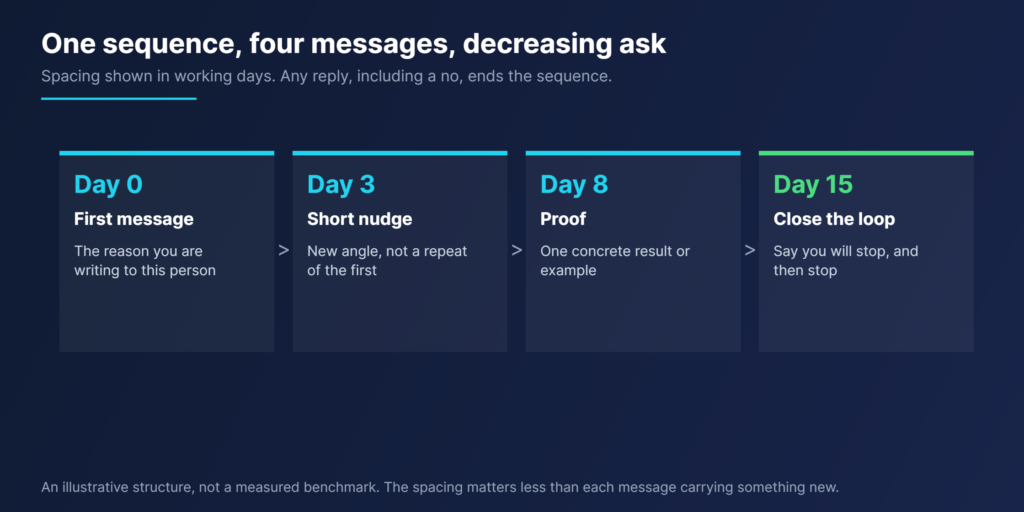
A structure that holds up across four messages
| Message | Spacing | What it adds | The ask |
|---|---|---|---|
| 1 | Day 0 | Why you are writing to this person specifically | A reply, or a short call |
| 2 | Day 3 | A different angle on the same problem | A yes or no |
| 3 | Day 8 | One concrete result or example | A question they can answer in a line |
| 4 | Day 15 | A clean exit | Permission to stop, which is still a reply |
The decreasing ask is the part people get backwards. Pressure usually rises through a sequence, when it should fall. By message four you are asking for a one word answer, which is the easiest thing a busy person can give you.
Why the last message gets the most replies
A message that says you will stop writing removes the cost of answering. There is nothing to negotiate and no meeting implied, so a reader who ignored three emails will often send two words. Some of those two word replies turn out to be “not now, try January”, which is a lead.
The condition is that you mean it. A fifth email after saying you would stop reads as a tactic, and the next person who recognises it will mark the whole domain as spam rather than replying.
Timing for SaaS specifically
Software buying has a cycle that most sequences ignore. Budget, renewal dates and a quarter ending all move a decision more than any follow-up does. A sequence that lands the week before a renewal performs differently from the same one sent at the start of a contract year, and nothing in the copy explains the gap.
That is an argument for keeping a record of no-but-later replies and returning to them on their timetable in whatever outreach tool you already use, rather than for sending more messages now.
What ends a sequence
| Signal | What it means | What to do |
|---|---|---|
| Any reply, including no | They answered | Stop the sequence, respond as a person |
| An out of office | Nobody read it | Pause until the return date, do not count it as a touch |
| A hard bounce | The address is dead | Suppress it, and check where the list came from |
| A complaint | Worse than silence | Stop sending to that segment and look at the list, not the copy |
| Four messages sent | The sequence is finished | Stop. Returning in six months is a new sequence |
Frequently asked questions
How many follow-ups should a cold sequence have?
Four messages is a reasonable structure when each one carries something new. The limit is not a count. It is whether you still have something worth saying, and most senders run out after three.
How long should I wait between emails?
Around three days early in the sequence and a week later on. Shorter gaps make the sequence feel automated, and longer ones lose the thread entirely. Treat the spacing as a starting point to measure, not a rule.
Should I reply in the same thread or start a new one?
Same thread keeps the context visible and is easier for the reader. A new thread with a fresh subject is worth trying only when the angle genuinely changed, because otherwise it reads as a second attempt at the same email.
Does a break-up email actually work?
It tends to produce the highest reply rate in a sequence, because answering costs nothing once no meeting is implied. It only works if you then stop, which is what separates it from another follow-up.
Bottom line
Write four messages that could each stand alone, space them over about three weeks, and make the ask smaller each time. Stop on any reply. If you cannot think of something new for message three, the problem is the offer rather than the sequence, and more emails will not fix it.
Related reading
- How many cold emails per day is safe: the thresholds that actually exist.
- GDPR and cold email: what changes when the list is not yours.
- B2B email verification: cleaning the list before the first send.