
The number people want is a single daily figure per domain. There is no published one, and the figures that circulate are guesses repeated until they sounded official. What does exist is a set of real thresholds, and they are about rates rather than counts.
The short version
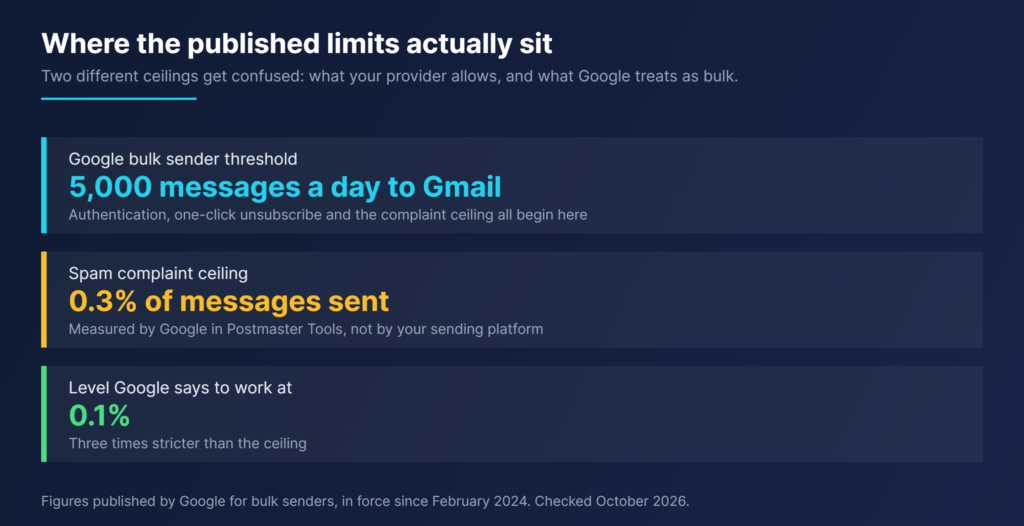
No mailbox provider publishes a per-domain daily cap for outreach. What Google publishes is a bulk sender threshold at 5,000 messages a day to Gmail and a spam complaint ceiling of 0.3%. Your own sending platform sets a separate limit, which is a billing and abuse control rather than a deliverability rule. Volume decisions should be built from complaint rate and domain age, not from a number copied off a blog.
Two ceilings that keep getting confused
The first is your provider’s own cap. Every sending platform and mailbox host sets one, and it exists to stop a compromised account mailing a million people overnight. Hitting it gets your sending paused. It says nothing about whether your mail was welcome.
The second is the threshold at which mailbox providers apply their bulk sender rules. Google and Yahoo introduced a shared set in February 2024. At 5,000 or more messages a day to Gmail addresses you have to authenticate with SPF, DKIM and DMARC, offer one-click unsubscribe, and keep spam complaints below 0.3%. Google names 0.1% as the level to work at.
Only the second ceiling has anything to do with reaching the inbox, and it is measured as a percentage. That is why a daily count cannot answer the question on its own.
Why the number you were given is probably made up
Common advice lands on something like fifty a day per mailbox. It is not published anywhere by a provider. It survives because it is cautious enough to be hard to disprove, and because a slow sender with a clean list does tend to do fine.
The reason it cannot be a rule is that two senders at the same volume get different results. Fifty a day to people who asked to hear from you is ordinary business mail. Fifty a day to a scraped file is a complaint rate climbing toward a threshold, and the volume was never the variable.
What actually governs how much you can send
| Factor | Why it moves the ceiling |
|---|---|
| Complaint rate | The measured figure Google acts on. Everything else is downstream of it |
| Domain age and history | A domain with months of normal mail absorbs a bad day. A two week old one does not |
| List source | Addresses that opted in behave differently from addresses that were bought |
| Bounce rate | High bounces signal a list that was never cleaned, before any complaint arrives |
| Reply rate | Genuine conversations are a positive signal. Mail nobody answers is not |
| Consistency | A flat daily pattern reads as normal. Nothing for a week then four thousand does not |
A way to pick your own number
Start low enough that a mistake is cheap, then let the measured complaint rate decide whether to move. The arithmetic is simple: at Google’s 0.3% ceiling, a 1,000 message day allows 3 complaints, and at the 0.1% target it allows 1. Those are small numbers, and they are the reason a new domain should not open at volume.
| Week | Daily volume per mailbox | What to watch before increasing |
|---|---|---|
| 1 to 2 | 20 to 30 | Any bounce above a couple of per cent means the list, not the volume |
| 3 to 4 | Double it | Complaint rate still near zero, replies arriving |
| 5 onward | Double again, to your provider’s cap | Rate steady as volume rises |
| Any week | Stop and halve | Complaints appear at all, or bounces climb |
Spreading the same volume across several domains does not change any of this. Each domain earns its own reputation, so five new domains sending badly is five bad reputations rather than one divided by five.
Frequently asked questions
How many cold emails per day is safe?
No provider publishes a figure. Start around 20 to 30 per mailbox on a new domain, watch bounces and complaints, and increase only while both stay near zero. The safe number is the one your own measurements support.
Does Google limit cold email specifically?
Google publishes requirements for bulk senders at 5,000 or more messages a day to Gmail, covering authentication, one-click unsubscribe and a 0.3% complaint ceiling. There is no separate published rule for cold outreach below that volume.
Should I use multiple domains to send more?
It raises capacity, not safety. Reputation attaches to each sending domain, so a bad list spread across several domains damages all of them. The approach only helps when the mail itself is in good shape.
What bounce rate should stop a campaign?
Bounces above a few per cent mean the list was not verified properly. Stop and clean rather than slowing down, because the addresses causing bounces will still be there at a lower volume.
Bottom line
Nobody publishes a per-domain daily cap because the thing that governs delivery is a rate, not a count. Start small on a new domain, read your bounce and complaint figures, and let those numbers set the pace. A volume that works for one sender tells you nothing about what works for another.
Related reading
- Google’s bulk sender rules: what changes at 5,000 messages a day.
- Hard bounce vs soft bounce: reading the reply code before you retry.
- B2B email verification: cleaning the list the bounces come from.